
Most people meet their air conditioning contractor on the worst possible day. The house is 84 degrees by noon, the kids are cranky, and whoever answers the phone first gets the job. That urgency is how homeowners end up with oversized systems, vague invoices or a refrigerant top-off that buys three weeks of comfort before the warm air returns.
A single visit actually reveals a lot. How a technician arrives, what he checks, what he asks and what ends up on paper afterward tend to separate a careful outfit from a careless one well before any real money changes hands.
Take mycoolzoneac.com, the website of an hvac company in Orlando that works out of South Orange Avenue. Its phone number, weekday and Saturday hours, financing application and featured equipment brands, Daikin and Goodman, all sit in plain view, along with discounts for veterans and first responders. That level of openness is a fair baseline to expect from anyone you let into your attic.
The Homework Worth Doing Before the Doorbell Rings
Florida licenses air conditioning contractors through the Department of Business and Professional Regulation. A certified contractor, whose license number usually begins with CAC, can work anywhere in the state, while a registered contractor is limited to the local jurisdictions where he qualified. Class A and Class B licenses differ mainly by system size, and a Class B covers nearly every home. State law also requires licensed contractors to print their license number in advertising, so a truck, website or flyer without one deserves a closer look.
Two more checks take only minutes. Ask for proof of general liability insurance and workers’ compensation coverage, because an uninsured worker who falls through your ceiling becomes your problem. And anyone handling refrigerant needs EPA Section 608 certification, which a reputable company will confirm without hesitation.
What the Phone Call Already Tells You
A good dispatcher asks real questions. How old is the system? Is the outdoor unit running? Is there water near the air handler, a tripped breaker or a strange noise? Those answers help the technician bring the right parts and arrive prepared.
You should also hear the diagnostic or trip fee up front. Be wary of anyone who quotes a full replacement price without seeing the house, or who pushes a deal that supposedly expires by the end of the day. Pricing a system sight unseen means guessing, and guesses rarely favor the homeowner.
The First Fifteen Minutes Inside Your Home
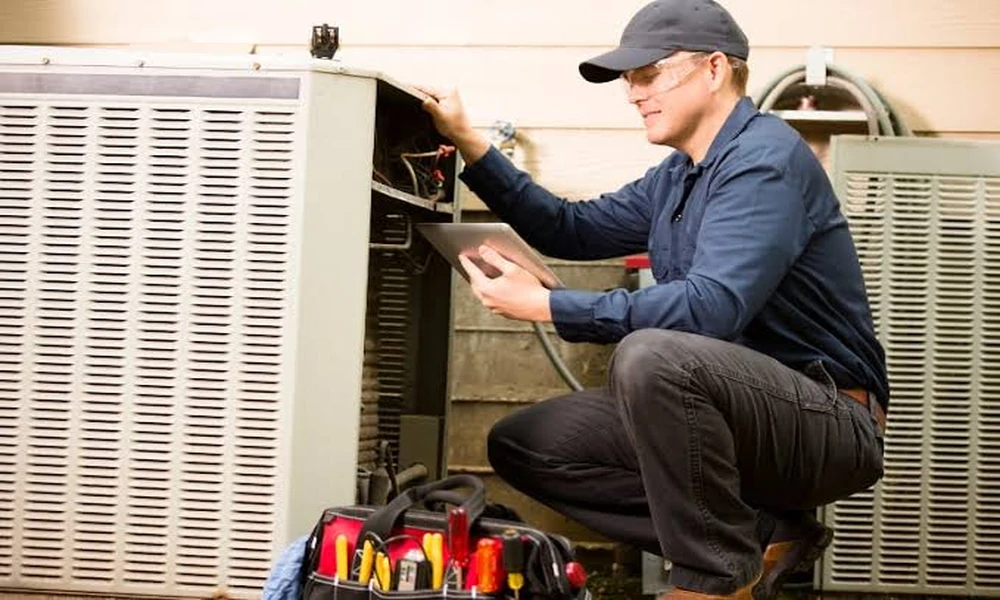
Watch where a technician goes first. Careful ones check the thermostat settings and the filter before touching anything else, since a clogged filter or a dead thermostat battery explains more service calls than most people would believe. From there, the air handler gets attention, along with the condensate drain and its float switch, which shuts the system down before an overflowing pan can soak a ceiling.
Outside, the condenser’s capacitor and contactor are common failure points in Central Florida, where heat, summer storms and power surges wear them out faster than in milder places. A thorough technician measures the temperature drop across the indoor coil and reads refrigerant pressures instead of judging by how the air feels on his hand.
Pay attention to how he talks about refrigerant. Air conditioners do not use it up. If the charge is low, there is a leak somewhere, and an honest technician says so plainly. Topping off the same system every summer without looking for the leak is one of the oldest habits in the trade and one of the most expensive for homeowners.
When the Conversation Turns to Replacement
If the system is near the end of its life, the visit should get longer, not shorter. Sizing a new unit by copying the tonnage of the old one is a shortcut that has left many Florida homes with equipment that cools fast, shuts off early and leaves rooms damp. A proper replacement starts with a load calculation, usually ACCA Manual J, which accounts for insulation, windows, sun exposure and how many people live there. Expect questions about rooms that never cool down and a look at the ductwork, since undersized or leaky ducts can cripple even premium equipment.
This is also where a contractor should explain what has changed in the industry. Since January 2025, new residential systems have been moving to lower impact A2L refrigerants such as R-454B and R-32, replacing R-410A. Efficiency floors have shifted too. Florida falls in the federal Southeast region, where most new split air conditioners and heat pumps must meet at least 14.3 SEER2. A contractor who walks you through those points, and through the long term tradeoffs of single stage versus variable speed equipment, is giving you the information you need to decide.
Paper That Protects You Later
A written estimate is where vague promises become enforceable ones. A solid proposal for a replacement should spell out the following.
- Exact model numbers for the outdoor unit, indoor coil and air handler, ideally with a matched AHRI certificate showing the rated efficiency of that combination.
- The full scope of work, including whether the refrigerant line set is being replaced or flushed, plus the pad, hurricane tie-downs, electrical disconnect, condensate line and thermostat.
- The permit. In Orange County, a mechanical permit is required for all permanently installed air conditioning and heating equipment, as the county explains on its permit requirements page.
- Warranty terms that separate the manufacturer’s parts coverage from the contractor’s own labor guarantee, along with who handles product registration.
- A payment schedule that does not demand the full amount before the work begins.
After the Truck Pulls Away
The job is not truly finished until the permit passes its final inspection. Ask for the permit number and check its status on the county portal a week or two later. Many homeowners skip this step and only learn about an open permit years later, when a buyer’s inspector finds it.
Walk outside and look at the condenser. It should sit level on its pad and be secured with tie-downs that meet Florida’s wind requirements. Ask for a startup record showing the refrigerant pressures and temperature readings taken when the system was commissioned, since that sheet becomes a useful benchmark for every future service call. Register the equipment warranty promptly if the contractor has not done it for you, because many manufacturers shorten coverage when registration is missed.
Systems in Central Florida run for most of the year, so a maintenance visit in spring and another in fall is a sensible rhythm rather than an upsell. The contractor who earns that ongoing relationship is usually the one who showed you, from the very first visit, exactly what was wrong, what it would take to fix and how you could confirm it was done right.