
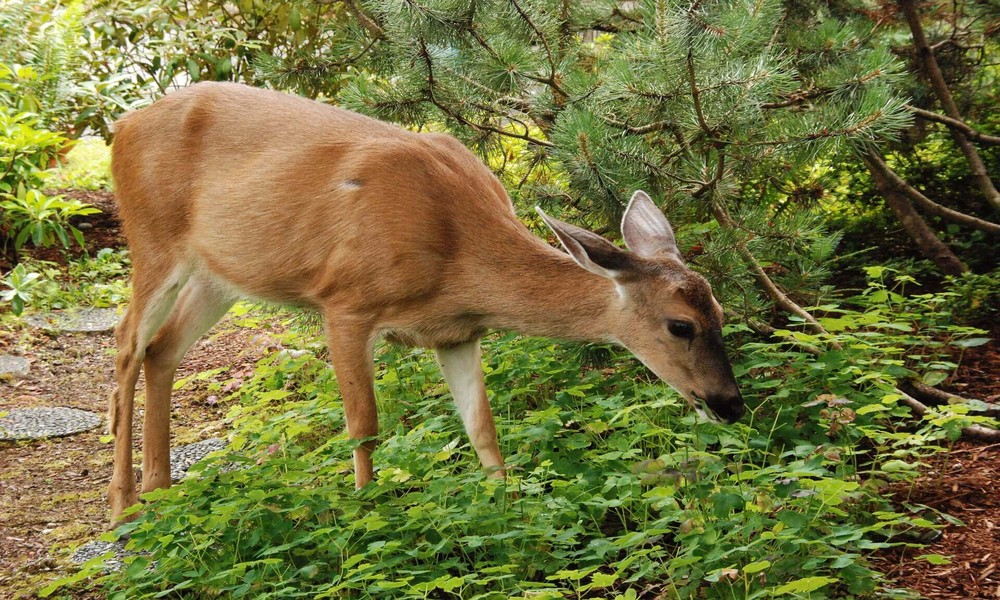

The first hard frost in late October usually coincides with the first round of phone calls about deer damage. Yew branches stripped bare, arborvitae browsed into a bonsai shape, rhododendrons chewed down to leafless stalks, tulip bulbs that never come up because last November’s deer beat spring to them. Lawn care in Newtown CT has to account for this cycle because the pressure is not going away. Fairfield County carries one of the highest deer densities in the state, and Newtown sits near the top of that distribution. Companies that work across lawn, landscape, and wildlife-damage management, including Tick & Turf in Southbury, see the same pattern repeat itself every winter.
The Deer Pressure Problem Around Newtown
The Connecticut Department of Energy and Environmental Protection has long considered 15 to 20 deer per square mile an ecologically sustainable density. Most wooded residential parts of Fairfield County run three to four times that figure. Newtown’s combination of large lots, woodland corridors, and minimal natural predation means the population stays high year-round, and in winter the pressure on landscape plantings climbs sharply as natural browse runs out.
The result shows up on most residential properties: a distinct browse line on evergreens, tulip and hosta beds that have become unreliable, and young trees scarred by antler rubs in late autumn.
How to Tell What Kind of Damage You Are Looking At
Deer damage comes in three distinct patterns, and each calls for a different response.
Browsing leaves torn, ragged edges on stems and leaves rather than clean cuts. Deer lack upper incisors, so they yank rather than snip. Fresh damage shows jagged stem ends and, on shrubs like yew and arborvitae, a classic truncated shape up to about five feet, the reach of an adult deer. Rabbits, by contrast, leave clean 45-degree cuts and work only below about two feet.
Rub damage shows up on saplings one to three inches in diameter, usually between September and December when bucks scrape velvet off new antlers. The bark is shredded in vertical strips, and the tree is often wounded deeply enough to kill it over the following year.
Turf damage is less common but real. Deer do not eat lawn grass to any significant degree, but their hooves punch holes in saturated soil, and newly seeded areas are sometimes grazed lightly or churned up by heavy traffic.
The Plants That Keep Getting Hit
The Rutgers Agricultural Experiment Station maintains the industry-standard list of deer resistance ratings, and it holds up well in Fairfield County. The plants rated “frequently severely damaged” line up almost perfectly with what gets replaced most often on Newtown properties: hosta, daylily, tulip, yew, arborvitae, eastern white cedar, rhododendron, azalea, and most hybrid tea roses.
The better-rated options include boxwood, Japanese holly, andromeda, most ornamental grasses, Russian sage, lavender, yarrow, coneflower, black-eyed Susan, and daffodils. No plant is truly deer-proof in a hard winter, but the spread in real-world damage between an A-rated and a D-rated plant is substantial.
What Actually Works
Four approaches carry most of the weight, and the best outcomes usually combine two or three.
Fencing is the only category that functions as a true barrier. An eight-foot woven wire fence is the standard recommendation for excluding deer entirely. In smaller yards, a pair of four-foot fences set four to five feet apart can work because deer struggle with depth perception and rarely jump a double barrier. Polypropylene mesh fencing around specific beds is inexpensive and effective for priority plantings.
Repellents work when rotated. Contact repellents based on putrescent egg solids, capsaicin, or garlic oil need reapplication after heavy rain, typically every three to four weeks during the growing season. Area repellents, hung rather than sprayed, supplement coverage. Deer habituate to any single product within weeks, so rotating between two or three different active ingredients is standard practice.
Plant selection is the slow fix. Replacing frequently damaged plantings with better-rated species over a few seasons reduces the damage baseline without any active intervention.
Motion-activated sprinklers, netting, and burlap wraps on vulnerable evergreens through the winter round out the toolkit. What does not work is worth naming too: ultrasonic devices, predator urine used alone without rotation, scented soap hung from trees, and mothballs, which are also illegal outside of their labeled use.
Where Lawn Care in Newtown CT Meets Winter Deer Protection
Most active-season repellent work is something a motivated homeowner can handle. The winter application is different. Deer pressure peaks between December and March, the products designed for winter use are formulated to stay on through freezing and thawing cycles, and getting even coverage on tall evergreens with a pump sprayer in January is awkward.
Professional winter programs, including the DeerPro Winter application offered by Tick & Turf and similar services, use long-lasting egg-based compounds applied once in late fall to carry plantings through the winter season. The application typically covers yews, arborvitae, rhododendrons, azaleas, and other high-value evergreens, and a single treatment usually holds until spring growth begins.
The Short Version
Deer damage in Newtown is not a run of bad luck. It is the predictable result of high deer density meeting a planting palette that happens to include the species deer prefer. Lawn care in Newtown CT that handles the problem realistically combines fencing for priority areas, rotated repellents during the growing season, better plant choices over time, and a professional winter application on vulnerable evergreens. A property walk-through with a local company that already handles lawn, landscape, and wildlife damage, such as Tick & Turf, is usually the fastest way to sort out which of those pieces the yard actually needs.