
Asbestos was valued for practical construction qualities long before its health effects were fully understood. It can remain hidden inside walls, floors, mechanical rooms, and exterior assemblies for decades after a building is completed. For anyone asking where asbestos hides in old buildings, the central concern is not simply whether the material exists, but whether renovation, deterioration, or maintenance could release fibers.
How asbestos was used for strength, insulation, and fire resistance
Asbestos fibers could be mixed into cement, vinyl, plaster, insulation, coatings, and other products to improve durability. The mineral also resisted heat and fire, which made it attractive around boilers, pipes, electrical components, and structural areas requiring protection. In some products, asbestos was tightly bound; in others, it was loosely incorporated and more easily disturbed.
The same qualities that made asbestos useful also allowed it to appear in many unrelated building materials. Its presence may therefore be distributed across a building rather than confined to one visibly unusual room.
Why asbestos may still be present in buildings constructed before modern restrictions
Older buildings often contain original materials that were never removed, even when later owners replaced fixtures or remodeled rooms. Restrictions and changing construction practices reduced new use over time, but they did not automatically eliminate asbestos-containing materials already installed. Renovations can also uncover layers beneath newer flooring, paneling, ceilings, or wall finishes.
A building’s age is a reason to investigate, not proof of contamination. The home asbestos guide describes how older residential properties may contain asbestos in insulation, flooring, and cement products, while also stressing that confirmation requires appropriate testing.
How asbestos-containing materials become hazardous when disturbed
Asbestos-containing material can become a concern when it is cut, drilled, sanded, scraped, broken, or removed. Water damage, impact, vibration, friction, and prolonged deterioration can also weaken some materials. Once fibers enter the air, they may be inhaled by workers, occupants, visitors, or people returning to the area later.
A material does not have to look dramatic to deserve caution. Disturbance is the turning point in many exposure scenarios, particularly during demolition or repairs that affect hidden layers.
Why exposure risk depends on fiber release, duration, and ventilation
Risk is shaped by how many fibers are released, how long people remain nearby, and how effectively the space exchanges air. Enclosed rooms, mechanical spaces, crawlspaces, and poorly ventilated work areas can allow airborne dust to linger. Repeated tasks may create concern even when each individual task appears small.
The condition and location of the material matter as much as the building’s age. A sealed product left intact may pose less immediate concern than a damaged or friable product beside a frequently used walkway, but only a qualified assessment can characterize the situation properly.
Where asbestos hides in common building materials
Asbestos was incorporated into many ordinary construction products, which is why a visual walk-through cannot reliably rule it out. Some materials are conspicuous, such as old pipe wrapping, while others are concealed beneath newer finishes. The following locations are common points for professional review, not a do-it-yourself identification list.
Insulation on pipes, boilers, ducts, and heating systems
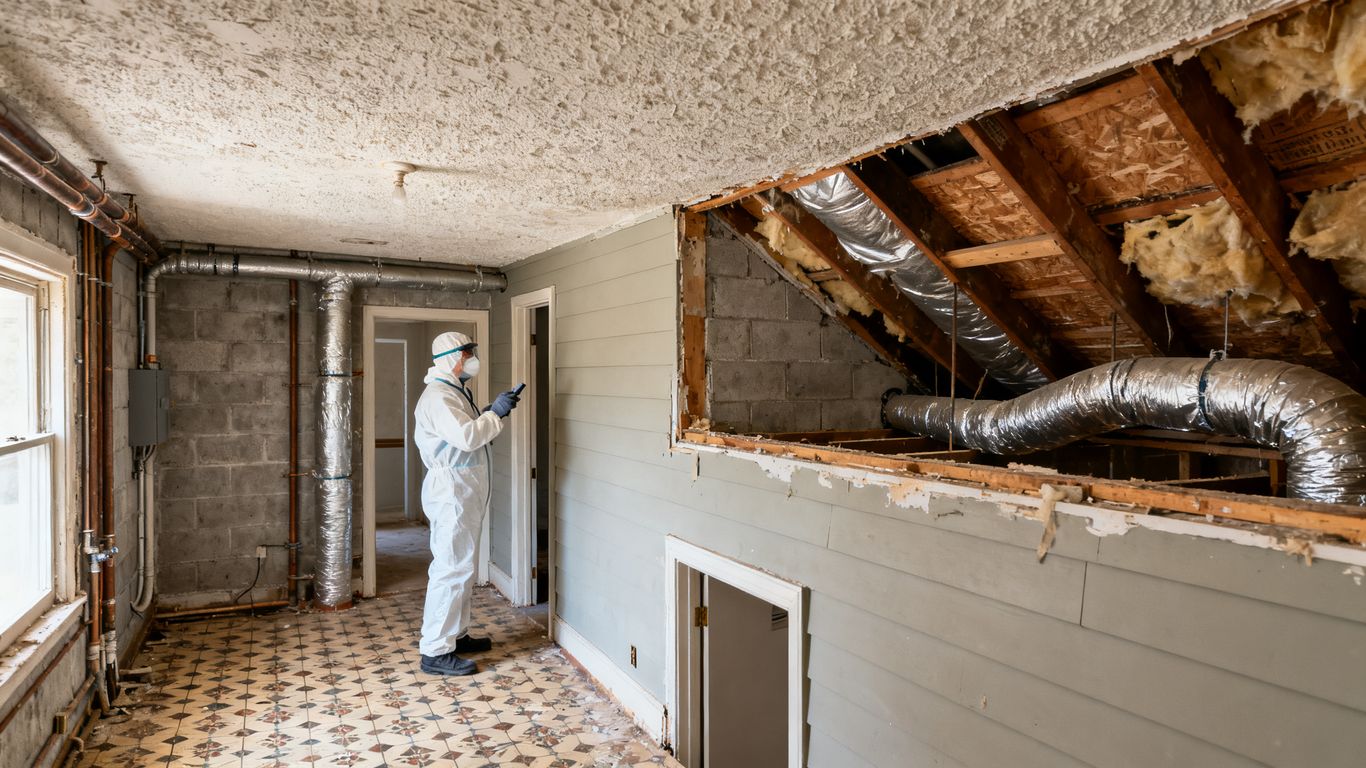
Mechanical rooms, basements, boiler areas, and service chases may contain insulation around hot-water pipes, steam lines, boilers, tanks, or ducts. The material can appear as wrapped sections, molded fittings, paper-like layers, cementitious coverings, or cloth around joints. Aging, impact, condensation, and maintenance can cause sections to crack or shed.
Because heating systems are routinely repaired and modified, their insulation may have been patched several times. A small opening around a valve or fitting can expose older layers that are not apparent from the surrounding installation.
Floor tiles, vinyl sheet flooring, and flooring adhesives
Older resilient floor tiles and sheet flooring may contain asbestos, as may some backing materials and adhesives beneath them. The adhesive can remain after the visible flooring has been covered with carpet, laminate, or newer tile. Removing flooring, scraping residue, or grinding a substrate can disturb more than the top layer.
The older-building asbestos locations guide also identifies vinyl floor tiles and adhesives as areas requiring attention in commercial properties. Flooring work should therefore begin with a review of the full floor assembly rather than an assumption that only the visible surface matters.
Ceiling tiles, textured coatings, and sprayed acoustic finishes
Ceiling systems may include asbestos-containing tiles, panels, insulation boards, or textured and sprayed finishes. Textured coatings can be concealed beneath paint, while suspended ceilings can hide older materials above the grid. Holes for lights, wiring, speakers, or ventilation may disturb a coating that otherwise appears stable.
Even a small ceiling repair can create dust over occupied areas. Before cutting into a ceiling or scraping a textured surface, building managers should determine whether the material has been assessed and whether the proposed work could affect adjacent areas.
Roofing, siding, cement panels, and exterior building products
Asbestos may occur in roofing products, siding, cement panels, pipe flues, fascia, and other exterior components. These materials can be relatively durable when intact, but weathering, drilling, cutting, pressure washing, or demolition may damage the matrix that holds fibers in place.
Exterior work can also affect people indoors if dust enters through open windows, doors, air intakes, or poorly sealed work zones. Diagrams of asbestos-containing building areas can help readers understand the range of locations that may warrant professional consideration, though diagrams cannot replace a site-specific survey.
Less obvious places asbestos may be found
The most difficult materials to recognize are often those that resemble ordinary plaster, insulation, caulk, or electrical hardware. They may be hidden behind finishes or present in small components rather than broad surfaces. This is one reason a narrow inspection of only the most familiar locations can miss relevant material.
Drywall joint compound, plaster, and decorative wall coatings
Joint compound, plaster, skim coats, and decorative coatings in older buildings may contain asbestos or may be applied over an asbestos-containing layer. Sanding a repair, removing wallpaper, scraping a finish, or opening a wall can generate dust from several materials at once. Painted surfaces do not prove that the underlying product is asbestos-free.
Wall work deserves particular care because dust can spread through occupied rooms and adjacent spaces. A planned repair should account for the coating, the substrate, and any debris that could be generated when fasteners or fixtures are removed.
Attic insulation, vermiculite, and fireproofing materials
Attics and wall cavities may contain loose-fill insulation, including vermiculite that could be contaminated with asbestos. Fireproofing may also appear around structural steel, ceilings, utility penetrations, or service shafts. Loose or friable materials can be especially vulnerable to disturbance from storage, wiring work, airflow, or foot traffic.
The safest response to unfamiliar attic insulation is to leave it alone and restrict access until it has been assessed. Moving boxes or installing recessed lighting can disturb material that was previously isolated from daily activity.
Electrical panels, wiring insulation, and heat-resistant components
Older electrical systems may include heat-resistant boards, wire insulation, arc chutes, panel backing, and other components that contain asbestos. These products are not necessarily obvious during a routine visual inspection, especially when they are inside enclosures or behind covers. Opening, cleaning, replacing, or modifying electrical equipment can create a disturbance risk.
Electrical work should be coordinated with the building’s asbestos information, where available. Qualified tradespeople can determine whether an asbestos professional needs to assess the equipment before work begins.
Window caulk, glazing compounds, door gaskets, and other sealants
Older windows and doors may contain asbestos in glazing compounds, caulk, gaskets, rope seals, or fire-rated components. These materials can be encountered during window replacement, reglazing, door repair, or the removal of frames. A sealant’s dark color, age, or texture cannot reliably establish its contents.
Small components still matter when they are repeatedly cut, scraped, or heated. A renovation plan should identify sealants and gaskets as well as the larger wall, ceiling, and floor materials surrounding them.
How asbestos exposure can affect the lungs
Asbestos-related disease is associated with inhalation of airborne fibers, not merely with the presence of an old material in a building. Fibers can remain in the body and contribute to inflammation and tissue damage over time. The health outcome depends on several factors, including exposure history, intensity, duration, and other risks such as smoking.
What happens when asbestos fibers are inhaled
When airborne asbestos fibers are inhaled, some can travel deep into the respiratory system. The body may struggle to clear fibers that lodge in lung tissue or the surrounding lining, prompting persistent irritation and inflammatory responses. The process is not necessarily accompanied by immediate symptoms.
Exposure can occur during work, cleanup, maintenance, or the movement of contaminated dust. The absence of an unpleasant odor or visible cloud does not show that the air is free of fibers.
Asbestosis and the development of lung scarring
Asbestosis is a chronic lung condition associated with inhaled asbestos fibers and progressive scarring of lung tissue. Scarring can make the lungs less flexible and may interfere with the transfer of oxygen. People with significant disease may experience breathlessness, persistent cough, fatigue, or reduced tolerance for activity.
These symptoms have many possible causes, so they cannot establish an asbestos-related diagnosis on their own. A clinician evaluates symptoms alongside occupational, residential, medical, and smoking histories.
Mesothelioma and other asbestos-related cancers
Asbestos exposure is associated with mesothelioma, a cancer affecting the thin lining around organs, most often the lining around the lungs. It is also associated with lung cancer and other serious diseases. The possibility of disease is one reason suspected asbestos should be managed before renovation rather than treated as ordinary construction dust.
The asbestos health risks guide discusses asbestosis, mesothelioma, and lung cancer in the context of suspected household exposure. Medical concerns should be discussed with a qualified healthcare professional, especially when a person has a known or possible exposure history.
Why symptoms may not appear for decades after exposure
Asbestos-related diseases can have long latency periods, meaning that symptoms may not develop until many years after exposure. A person may feel well while disease processes are developing, and a past exposure may be overlooked if building or employment records are incomplete. This delay does not mean that every exposure leads to illness, but it does make accurate history important.
Anyone concerned about past exposure should provide a clinician with as much detail as possible about the building, task, duration, protective measures, and timing. New or persistent respiratory symptoms merit medical attention regardless of their suspected cause.
How to assess suspected asbestos safely
No one should rely on a quick visual check to decide that an older material is safe to disturb. Products that contain asbestos can resemble products that do not, and the same material may vary by manufacturer, installation date, or location. A cautious assessment begins by stopping work and preserving the material’s condition.
Why building age and appearance cannot confirm asbestos content
Building age can indicate that asbestos is possible, but it cannot confirm that a particular product contains it. Color, pattern, texture, labeling, and fiber-like appearance are similarly unreliable. Newer layers may conceal older materials, and a material that looks modern may have been installed during an earlier renovation.
Records can provide useful context, but documentation may be incomplete or inaccurate. Confirmation generally depends on appropriate sampling and laboratory analysis performed under applicable professional procedures.
Signs that materials may require professional evaluation
Cracking, crumbling, water damage, exposed layers, abrasion, and visible debris are reasons to stop disturbing a material. Planned work that will penetrate, remove, or demolish an older finish also warrants evaluation, even when the material appears intact. Areas around heating systems, ceilings, floors, walls, and service penetrations deserve particular attention because they often contain multiple layers.
A building owner or occupant should keep people away from damaged material and avoid sweeping, vacuuming with ordinary equipment, scraping, or collecting fragments. The condition should be documented from a safe distance while the next step is arranged.
When to arrange testing by an accredited asbestos professional
Testing is appropriate when renovation, repair, demolition, maintenance, or damage could disturb a suspect material. It may also be sensible before purchasing or occupying an older building when the condition or location of materials is unknown. An accredited professional can determine where samples are needed and how the work area should be controlled.
The goal is not to test every surface indiscriminately. It is to identify materials that could be affected by the planned work and to support a safe management decision.
Why sampling and laboratory analysis should not be done casually
Sampling can release fibers if a material is cut or broken without proper controls. A casual household sample may also be taken from the wrong layer, contaminated, mislabeled, or handled in a way that exposes the sampler and others. Laboratory analysis is meaningful only when the sample represents the material that will actually be disturbed.
For that reason, occupants should not scrape a ceiling, chip a tile, or mail an improvised fragment for testing. Professional sampling and interpretation reduce unnecessary disturbance and help connect test results to a practical renovation plan.
What to do before renovating or repairing an old building
Renovation is often when hidden asbestos becomes an immediate concern. A project may affect floors, walls, ceilings, mechanical systems, or exterior materials that were not visible during initial planning. A written process gives owners and contractors a chance to address those materials before dust and debris are produced.
Creating an asbestos survey and renovation plan
The project should begin with a review of building records, previous surveys, planned work, and the materials in the work area. Where information is missing, an appropriately qualified asbestos professional can inspect suspect materials and arrange representative testing. The resulting plan should identify affected areas, control measures, responsibilities, and the sequence of work.
The plan should also address hidden spaces that the project may open, such as cavities behind cabinets, layers beneath flooring, ceiling voids, and service chases. Treating those spaces as part of the project prevents surprises after demolition has begun.
Preventing fiber release during drilling, sanding, or demolition
Workers should not drill, sand, scrape, cut, grind, or demolish suspect materials until their status and the required controls are established. Ordinary dust-control habits are not a substitute for asbestos-specific procedures, equipment, containment, and waste handling. Work methods should be selected to limit disturbance and prevent dust from moving beyond the controlled area.
Before work starts, the project team should confirm who is authorized to perform the task and how the area will be isolated. These practical decisions are more effective when made during planning rather than in response to an unexpected dusty surface.
Keeping occupants away from damaged or disturbed materials
Occupants, visitors, pets, and unrelated workers should be kept away from suspect materials and active work zones. Doors, ventilation pathways, and access routes may need to be managed so that dust cannot spread into occupied parts of the building. Children and people with respiratory concerns should not enter an uncontrolled area.
If accidental disturbance occurs, people should leave without sweeping or attempting household cleanup. The area can then be secured while qualified professionals determine whether further assessment, cleaning, or remediation is required.
Understanding contractor, disposal, and workplace safety requirements
Asbestos work may be subject to licensing, training, notification, containment, air monitoring, transport, and disposal requirements that vary by jurisdiction and by the type of building or project. Owners should confirm qualifications and responsibilities before hiring a contractor, rather than assuming that a general renovation crew is prepared for asbestos work. Written records, work plans, and clearance documentation can help demonstrate that the project was managed properly.
The professional asbestos assessment guidance explains why disturbance during construction, renovation, or demolition can release fibers and why professional evaluation matters. With the right planning, suspected material can be managed deliberately instead of becoming an airborne hazard in the middle of a repair.